
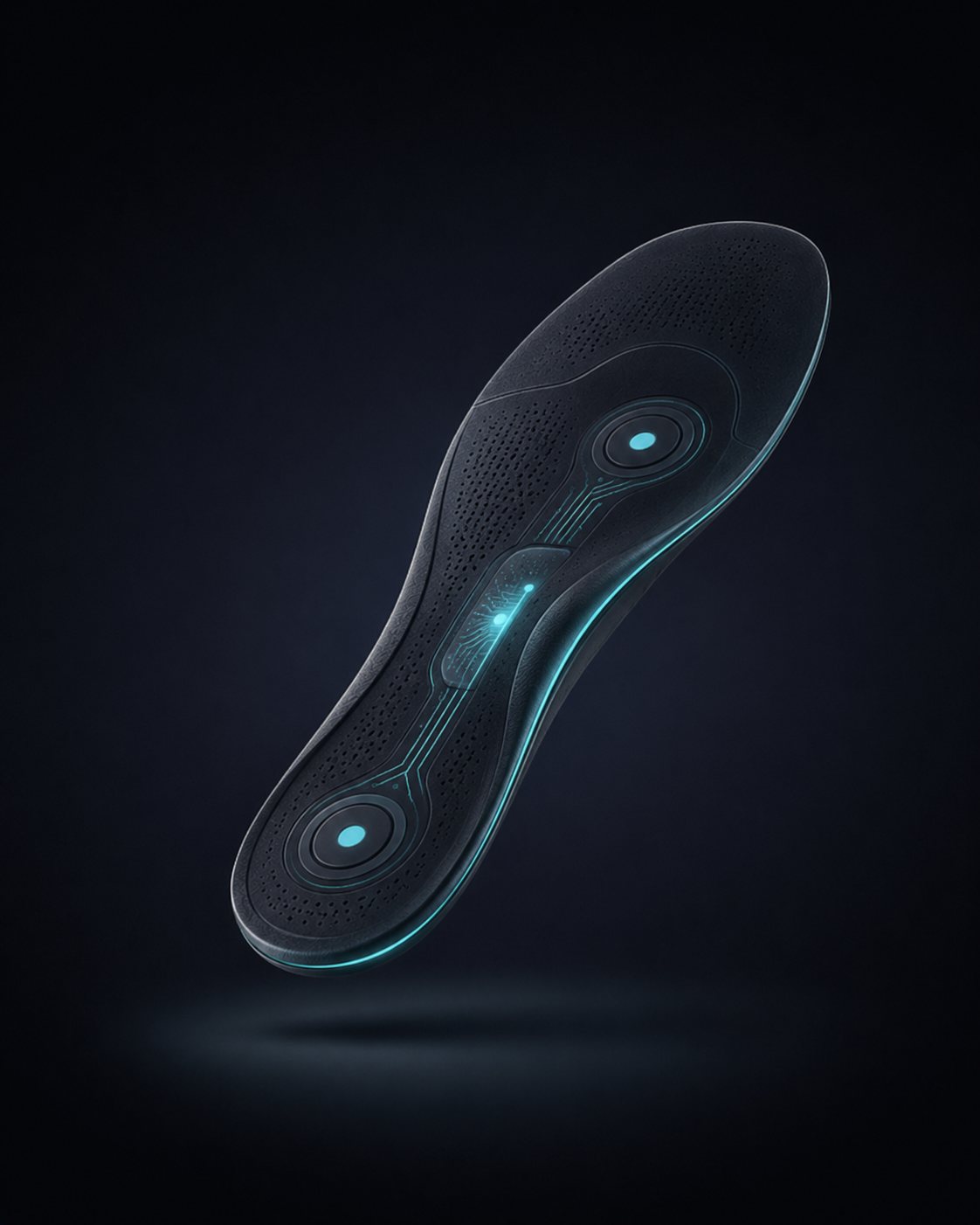
A connected insole
Continuous gait monitoring and real-time fall prediction, designed for elderly users in independent and assisted living.
Case study · Client anonymized — published with approval
A connected insole, real-time AI and a defensible IP position — built end-to-end for a specialty healthcare provider.
AI-assisted code generation can accelerate firmware. It cannot design an antenna inside an insole, partition inference across device and cloud, close a sub-$50 BOM, or pass medical-grade qualification. Axon Labs operates where those decisions are made — system architecture, hardware design and commercial defensibility.
The problem
Falls are one of the most preventable causes of injury in elderly populations — and one of the hardest to monitor unobtrusively. Wristbands get removed, cameras feel invasive, and most consumer wearables track activity, not risk. A specialty healthcare provider came to Axon Labs with a different vision: predict falls before they happen, from a place no one ever takes off — the foot.
The client
Continuous gait monitoring and real-time fall prediction, designed for elderly users in independent and assisted living.
Strong clinical understanding, but no team capable of taking the concept through hardware, AI integration, certification and patentability.
Deliver the device end-to-end and secure the intellectual property to defend it commercially against fast-moving competitors.
The challenge
Every constraint was non-negotiable. Together, they defined the engineering envelope.
Sensors, MCU, antenna and battery — all inside an insole, without compromising LTE-M signal quality.
Mass-production cost target leaves zero room for over-specified components or redesign loops.
On-device inference for fall prediction; cloud AI for trend analysis — partitioned for latency, privacy and power.
Continuous gait monitoring with no missed steps and minimal user intervention or charging.
Documentation, traceability and signal-integrity simulation — engineered for medical-grade qualification.
System architecture
A four-layer architecture moves data from physical motion to predictive insight in under a second.
Multi-sensor fusion captures gait pattern, balance and location.
Real-time fall-risk inference — runs even with no connectivity.
Antenna co-designed for the constrained insole geometry.
Long-horizon trend modeling, alerts to caregivers and family.
End-to-end latency target: under 800 ms from sensor reading to actionable alert.
Engineering deep dives
An insole is one of the worst RF environments in consumer electronics: surrounded by ground plane, sweat and a body that absorbs LTE-M signal. We co-designed a PIFA antenna with the PCB outline and enclosure, using full-wave electromagnetic simulation at every iteration, validated to LTE-M Cat-M1 on a 4-layer controlled-impedance stack-up.
On-device: a quantized model detects fall-risk gait patterns in under 100 ms within an MCU memory and milliwatt power budget — offline by design. In the cloud: long-horizon models learn user-specific baselines, detect drift and generate caregiver alerts, improving through fleet-wide learning.
Commercial engineering
In medical hardware, every dollar of BOM is fought for. The target was locked at architecture stage — every later trade-off was measured against it.
Single-MCU architecture — no over-spec, no headroom we wouldn’t use.
Fewer sensors that work harder, validated through simulation.
Eliminated dedicated RF front-end real estate by integrating early.
Manufacturing constraints were design inputs, not late-stage corrections.
IP & defensibility
Engineering services typically end at sample release. We treat patentable invention as a deliverable.
We map the engineering decisions that are genuinely new — and separate them from prior art that already protects competitors.
Engineers maintain invention disclosures alongside design documentation, with timestamps and trace to architectural decisions.
We work with the client’s IP counsel to articulate claims technically — translating engineering depth into defensible patent language.
Deliverables
Named artifacts — every one of them auditable, reusable and ready for production handoff.
End-to-end architecture, design rationale and traceability from requirements to implementation.
Schematics, layout, BOM and signal-integrity simulation reports.
Manufacturing-ready files: gerbers, assembly, test and DfM specifications.
Full source, delivered under MIT license, with build, test and deployment documentation.
Operational documentation, user-facing instructions and certification-aligned dossiers.
Invention disclosures and technical claims documentation for patent filing support.
Tell us what must become technically and commercially real.